![turfrad_logo_outlines (1)-1.svg]](https://support.turfrad.com/hubfs/turfrad_logo_outlines%20(1)-1.svg)
How you drive while scanning has a direct impact on how measurements are distributed across the fairway.
Each turfRad sensor records 10 measurements per second. The goal is therefore not simply to collect as many measurements as possible, but to distribute those measurements evenly across the area you want to map.
Following a consistent scanning pattern helps produce more complete and evenly distributed moisture data.
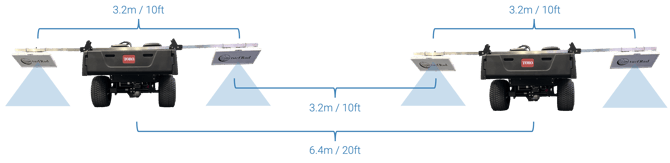
First: Stay inside the Fairway boundary and keep both sensors over the fairway while scanning.This is especially important when using an array mount. Even if the vehicle itself is still on the fairway, the outer sensor can already be positioned over the rough.
To avoid this, leave a small buffer between your driving line and the fairway edge. When approaching the boundary, drive a few meters inside the fairway so both sensors remain over the surface you want to measure.
Best practice: Stay slightly inside the fairway boundary rather than trying to follow the edge as closely as possible.
Second: Drive organized, evenly spaced passes. More passes do not automatically correspond better data or maps.
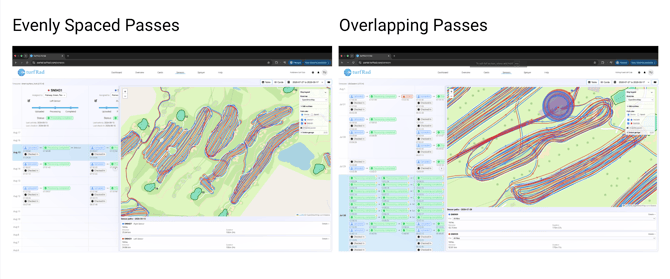
Because the sensors are continuously collecting measurements as you drive, random or unnecessarily overlapping passes can create areas with many measurements while leaving other parts of the fairway with fewer measurements.
Instead, scan the fairway systematically using evenly spaced passes.
A smaller number of organized passes can provide better overall coverage than making additional random passes across the same area.
Best practice: Plan your route before scanning and work across the fairway in a consistent pattern with evenly spaced passes. You can see your Scan Route & Driving Statistics in the Sensors tab in the turfRad Portal after driving: Read about it in the Portal here: Sensor Hardware & Data Upload Status
Third: Maintain a consistent driving speed.
Each turfRad sensor records measurements at a fixed rate of 10 measurements per second.
This means your driving speed determines the distance between individual measurements along your path:
- Slower driving will place more measurements inside the sprinkler radius and can help reduce outlier data indicators. Also read: Overview Map Layers
- Faster driving creates more distance between measurements.
Changing speed significantly during a scan can therefore create different measurement densities across the same fairway.
Best practice: Choose a suitable driving speed and keep it as consistent as possible throughout the scan.
The Goal: Consistent CoverageA good scan is not defined by how many times you drive across the fairway. What matters is how evenly the measurements represent the entire area.
For consistent sampling:
- Keep both sensors inside the fairway boundary.
- Leave a buffer at the edge when using an array.
- Use organized, evenly spaced passes.
- Maintain a consistent driving speed.
- Avoid unnecessary random or overlapping passes.
Key Takeaway
Prioritize even coverage over the number of passes.
Stay inside the fairway, follow an organized scanning pattern, and maintain a consistent speed throughout the scan.