![turfrad_logo_outlines (1)-1.svg]](https://support.turfrad.com/hubfs/turfrad_logo_outlines%20(1)-1.svg)
This article explains the relation of the mounting height to the measured area and mounting principles for the height of the sensor.
In simple terms:
-
Sensor height ≈ measurement footprint diameter
-
Lower height → smaller footprint, higher spatial resolution
-
Higher height → larger footprint, more averaging
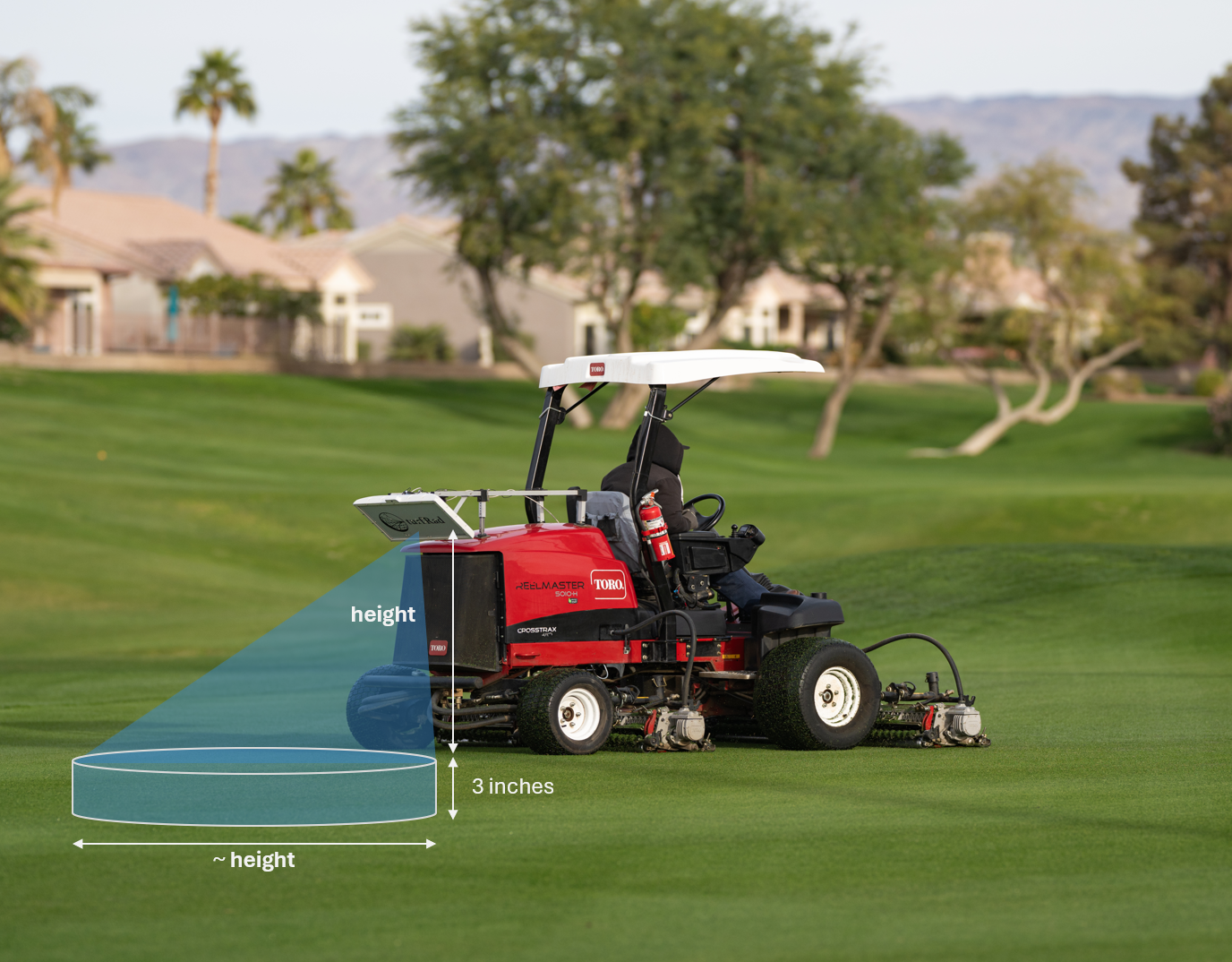
You can imagine that the sensor is measuring a cone like a flashlight, and the further up you take the flashlight, the larger the area measured in one pixel.
Matching the Measurement Grid
For best results, the measurement footprint should be roughly the same as your effective measurement grid, for example:
-
The cutting width of a fairway mower
-
The wheel track or spacing of a measurement cart
This ensures:
-
Clean spatial separation between measurement lines
-
Consistent coverage without oversmoothing
As a rule of thumb:
Footprint diameter <= mower or cart width
Typical Example
-
If your mower or cart grid spacing is ~1.5 m (≈ 5.0 ft)
-
Set the turfRad sensor mounting height to ~1.2–1.5 m (≈ 4.0–5.0 ft)
This results in a ground footprint that aligns well with pass-to-pass spacing, providing good spatial resolution without excessive overlap.
Minimum Mounting Height
Due to antenna physics and the operating frequency, the turfRad sensor must be mounted at a minimum height of 0.75 m (2.5 ft) above the ground.
Key Takeaways
-
Height ≈ footprint diameter
- mount the sensor at a minimun height of 0.75 m (2.5 ft)
-
The footprint should be roughly equal to the measurement grid for best results (the "missing" space between passes will be interpolated)
- Make sure the angle of the sensor is 40° (as shown below)
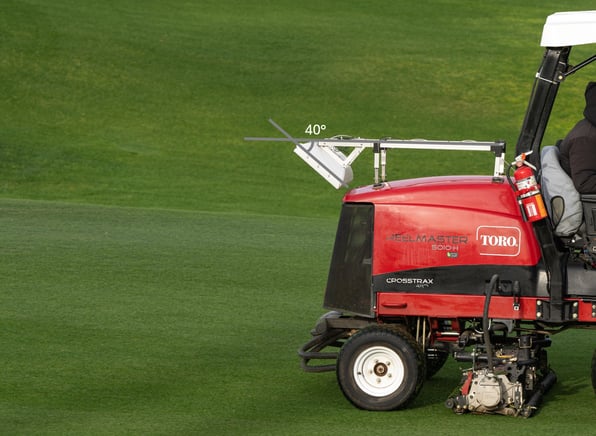
If you need help selecting the optimal height for your specific mower or cart, don't hesitate contact turfRad support.