![turfrad_logo_outlines (1)-1.svg]](https://support.turfrad.com/hubfs/turfrad_logo_outlines%20(1)-1.svg)
In the turfRad Portal, on the right side of the Overview map, you’ll find the moisture colorbar.
Here you can:
- choose your Midpoint moisture level (green)
- adjust the MIN (red) and MAX (blue) thresholds
- or, in Sprinkler View and Discrete View, adjust the HIGH (blue) and LOW (orange) settings that classify sprinklers into moisture categories
These settings influence how the moisture data is being displayed — and they each serve a different purpose..png?width=670&height=407&name=turfRad-vs-NDVI-tabelle%20(1).png)
Graphic: left = MIN/MAX settings in Overview tab; right = HIGH/LOW settings in Sprinkler View and Discrete View
1. MIN/MAX in Overview Tab - Adjust Map Contrast
MIN and MAX control the endpoints of the color scale:
- MIN → moisture level shown as dark red (very dry)
- MAX → moisture level shown as dark blue (very wet)
- Default range: MIN = 0% (very dry) → MAX = 50% (very wet)
This is useful when you want more contrast to highlight subtle moisture differences, and your typical moisture range is narrower than the default settings.
-1.png?width=670&height=438&name=turfRad-vs-NDVI-tabelle%20(2)-1.png)
Graphic: Same fairway, two different MIN/MAX settings → notice how contrast changes what becomes visible.
2. HIGH/LOW in Sprinkler View – Control Category Boundaries
In Sprinkler View, the colorbar categorizes sprinklers into 5 categories: Very Wet, Wet, Target, Dry, Very Dry. The HIGH/LOW settings determine which sprinklers fall into which categories.
.png?width=670&height=407&name=turfRad-vs-NDVI-tabelle%20(3).png)
Graphic: In the first screenshot, the HIGH/LOW range is wide, so most sprinklers fall into the “Target” category. In the second, narrowing the HIGH/LOW range reveals more Wet/Dry variation across the same area.
3. HIGH/LOW in Discrete View – Define Pixel Color Breaks
The Discrete View displays moisture as five solid color bands, rather than a gradient. HIGH/LOW here control where those color transitions occur:
- HIGH → when pixels turn blue (wet)
- LOW → when pixels turn orange/red (dry)
This helps because “wet” or “dry” means something different on every course:
- A sand-based profile may consider 22% VWC “wet”
- A native-soil profile may consider 30% “wet”
- A links-style course may define “dry” much lower
Adjust HIGH/LOW to match your real course conditions.
.png?width=670&height=407&name=turfRad-vs-NDVI-tabelle%20(4).png)
Graphic: Same discrete map, two HIGH/LOW settings → dramatically different visibility of wet/dry extremes.
Putting It All Together
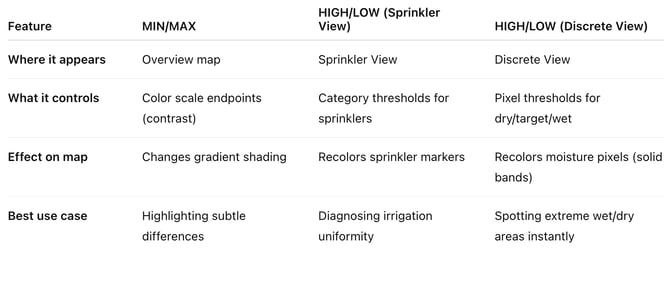
- MIN/MAX → change contrast of the heatmap (Overview tab)
- HIGH/LOW (Sprinkler View) → change sprinkler categories
- HIGH/LOW (Discrete View) → change pixel color thresholds
Each setting shows the same data from a different perspective — helping you diagnose moisture patterns or irrigation performance more effectively.