![turfrad_logo_outlines (1)-1.svg]](https://support.turfrad.com/hubfs/turfrad_logo_outlines%20(1)-1.svg)
Short answer: Yes. turfRad can be used on greens, and many teams are already doing so successfully.
Important context: Greens scanning is an emerging use case, and best practices continue to evolve based on real-world feedback.
How turfRad Collects Moisture Data on Greens
turfRad sensors passively collect continuous subsurface moisture measurements as the sensor moves across the turf. These measurements are then processed and displayed as a moisture map in the turfRad Portal.
Display Resolution: Greens vs. Fairways
To better match surface size and use case, turfRad displays data differently depending on the area being scanned:
-
Fairways:
Data is displayed on a 1.0 m × 1.0 m grid, which aligns well with fairway scale, irrigation spacing, and operational decisions. -
Greens:
Data is displayed on a 0.3 m × 0.3 m grid, resulting in a smoother-looking map with finer visual detail.
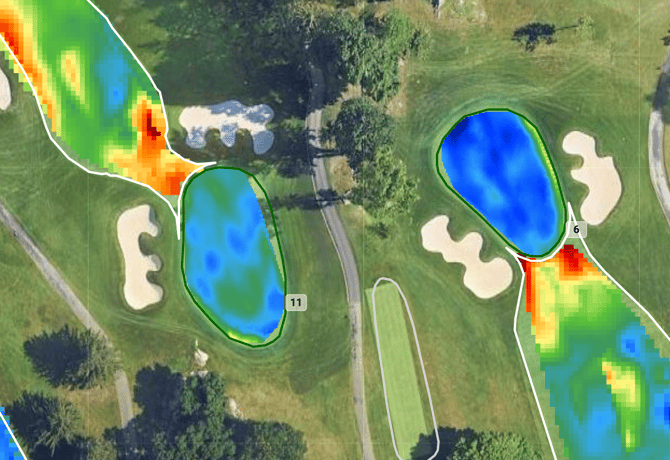
This difference in display resolution is why greens maps may appear visually smoother than fairway maps - it is a function of how the data is gridded and interpolated, not a change in the underlying measurement physics.
Interpolation Explained
On greens, sensor passes are often farther apart than 0.3 m. turfRad uses physics-based interpolation to estimate values between measured paths and display the data consistently at 0.3 m intervals.
Using Single-Point Readout on Greens
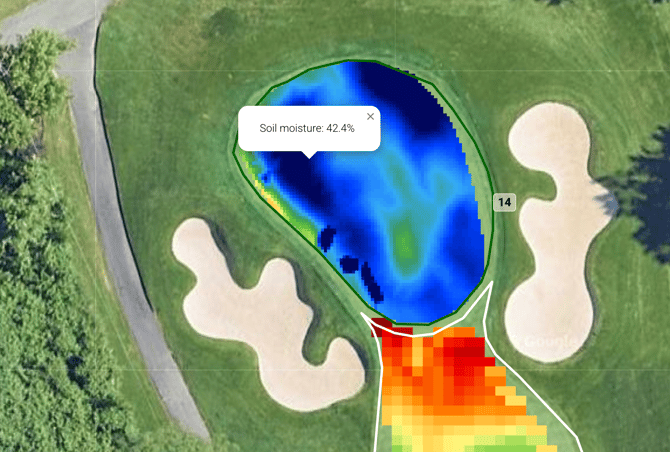
The feature Single-Point Readout remains available on greens. This means you can still click any point on a scanned green and instantly see the measured volumetric water content (VWC)
Practical Workflow: turfRad + TDR on Greens
Most teams using turfRad on greens combine tools rather than replacing existing ones. A common workflow looks like this:
-
Scan greens with turfRad during routine operations
-
Use the moisture map to identify wetter or drier zones
-
Use Single-Point Readout to check values at specific locations, optionally confirm with a TDR or probe
-
Make targeted hand-watering or irrigation decisions
This approach reduces guesswork and helps focus time and labor where it matters most.
Mounting Requirements for Greens Scanning
Minimum Sensor Height
To ensure accurate geometry and signal stability, turfRad sensors must be mounted at least ~2 ft (0.6 m) above the turf surface.
Because of this height requirement, turfRad should not be used on walking greens mowers.
It can be used on Rollers, Triplex mowers, or Utility vehicles (UTVs).
As with fairway scanning, stable mounting, consistent speed, and clear GPS reception are important for clean results.
Current Limitations and Ongoing Development
Greens scanning is still an evolving workflow. While turfRad already provides meaningful value on greens today, ongoing development and feedback continue to shape how this feature is refined.
What turfRad does not claim:
-
It does not fully replace probe-based point measurements
What turfRad does provide:
-
Spatial context across the entire green
-
A fast way to see where to focus attention first
Summary
Greens demand precision, but precision starts with context.
turfRad provides that context by offering a spatial moisture overview of greens, displayed at a finer grid than fairways and supported by tools like Single-Point Readout. Used alongside traditional probes, turfRad helps turf managers make more focused, confident decisions on some of the most critical surfaces on the course.
As greens workflows continue to evolve, turfRad will continue evolving with them.